Quick answer
Choose signage for a Dubai business by how customers reach you. Drivers need a large, lit sign facing the road; walkers need a fascia plus a projecting sign; mall and tower visitors need a clear name and good wayfinding. A sign gets noticed when it contrasts with its neighbours, not only its background. As a rule of thumb, allow 2.5 cm of letter height per 3 metres of reading distance.
Key takeaways
- Put most of the budget on the sign customers see first, which depends on whether they drive, walk or arrive by lift.
- On a busy street, a sign stands out by being different from its neighbours, not brighter than them.
- Size letters for the real distance: about 2.5 cm of letter height per 3 metres, using bold letterforms that stay readable when lit.
- Lit faces and drivers are what fail in summer heat. Ask how a face is reprinted and how a driver is replaced before you order.
On this page (9 sections)
- Start from how customers find you
- Which signs each type of business needs
- What makes a sign get noticed on a crowded street
- Lit or unlit: decide by your hours and your street
- What fails first in Dubai heat, and how to plan for it
- Where to spend first when the budget is limited
- Get the approval right before fabrication
- Frequently asked questions
- Send us your shopfront and your street
A new tenant usually gets a signage quote with five or six options on it: 3D letters, a lightbox, a pylon, LED neon, window graphics, a reception logo. Each one is a reasonable product, and a sign maker will happily make all of them. The real question is which ones your business needs, and which one deserves most of the money.
After years of surveying units from Deira and Karama to Al Quoz warehouses and Business Bay towers, we answer that by watching how customers arrive, not by looking at the catalogue. This guide gives you the same method: work out where you are seen from, choose the sign that does the heavy lifting, and design it to stand out from the signs around it.
Start from how customers find you
Most Dubai businesses fall into one of four arrival patterns, and each points to a different main sign.
- Drivers. Showrooms, garages, warehouses and anything on a service road beside Sheikh Zayed Road or in Al Quoz. The customer has seconds to read the name and find the turning. The main sign is large, high and usually lit, facing the traffic.
- Walkers on a street. Shops and restaurants in Karama, Satwa or Deira. People approach along the pavement, often under a colonnade, so they see the shopfront at a sharp angle until they are almost at the door. A fascia alone is not enough; a projecting sign at right angles to the wall catches them earlier.
- Mall and podium visitors. They walk a corridor at a few metres from your glass. The mall controls the sign zone, so the name above the unit and the window do most of the work.
- Appointment visitors. Clinics, offices and training centres. These visitors already know your name. What they need is to find the right building, floor and door without asking. Wayfinding matters more than a big logo.
The rule we use: the sign seen first gets the biggest share of the budget. Everything else supports it.
Which signs each type of business needs
These are the combinations we recommend most often. Use the row closest to your business as a starting brief, then adjust for your building.
| Business | Main sign | Supporting signs |
|---|---|---|
| Cafe or restaurant on a street | Lit 3D letters on the fascia | Projecting sign, lightbox menu by the door, window hours |
| Clinic or pharmacy | Evenly lit fascia readable at night | Frosted privacy film, floor and room wayfinding |
| Mall retail unit | Name in the mall's sign zone, to their rules | Window graphics that change by season |
| Warehouse or workshop in Al Quoz or Ras Al Khor | Large ACP board visible from the access road | Gate sign, bay numbers, safety signs, branded vans |
| Office in a tower | Reception logo behind the desk | Lobby directory listing, door plates, glass manifestation |
| Showroom set back from the road | Pylon at the road edge | Facade letters, entrance and parking signs |
How each of these is built is on our service pages: street-facing signs on outdoor signage, and reception, office and wayfinding signs on signage maker in Dubai.
What makes a sign get noticed on a crowded street
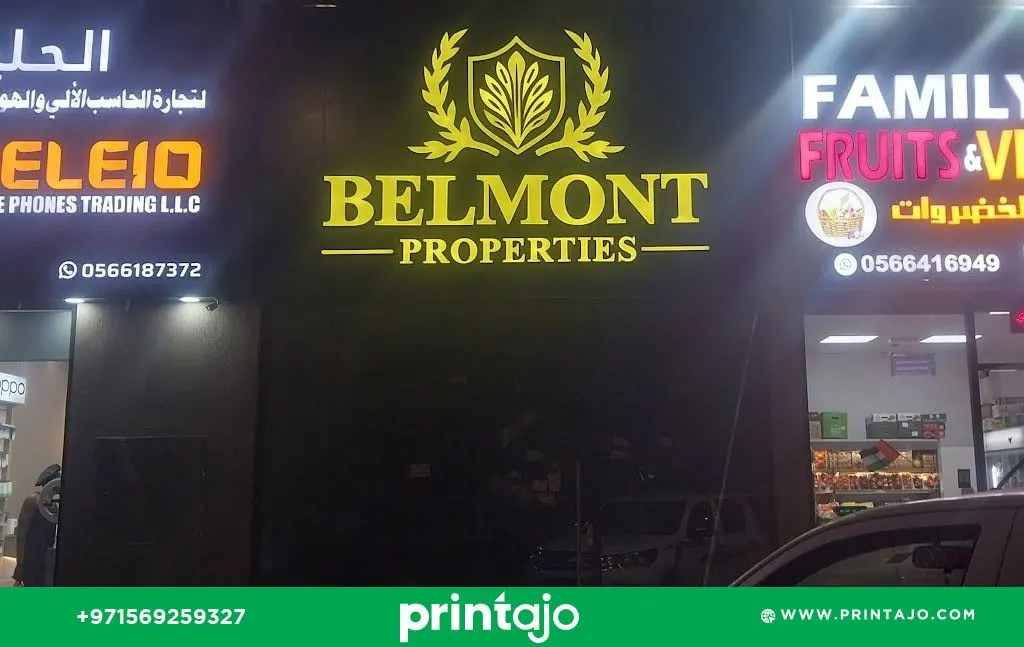
Walk down any busy Deira street at night and you will see the problem: a row of white-faced lightboxes with red and blue letters, each one as bright as the next. Adding a brighter one does not win. Being different does. In the photo above, gold letters on a black fascia stand out precisely because the neighbours are bright and busy.
Contrast with the neighbours, not just the background
Before designing, photograph the signs either side of your unit. If they are all white boxes, a dark fascia with lit letters will read. If they are all dark, a clean light face will.
Letter size for the real distance
A common sign-industry rule of thumb is about 2.5 cm of letter height for every 3 metres of comfortable reading distance. A name read from across a 20-metre street needs letters of roughly 17 cm or more, and bigger if it is read from a moving car.
Fewer words
Name, what you do, and nothing else. A phone number on a fascia is rarely read, and a list of six services shrinks the name. If the name does not explain the business, add one word.
Clear sightlines
Trees, shade structures, covered parking and delivery vans all block low signs. We check the view from where customers actually stand, at the times they visit, before setting the height.
Lit or unlit: decide by your hours and your street
In summer, a lot of Dubai trade moves into the evening, and an unlit sign effectively closes at sunset. Our outdoor signage page compares front-lit, halo-lit and lightbox options in detail. The decision rules we give clients are simpler.
- Trade after dark: light it. Check your street at 9 pm, not at noon, before you choose.
- Daytime only, industrial area: an unlit ACP board facing the road is often enough. Spend the difference on size.
- Thin letters blur when lit. Light spreads at the edges, so a fine serif or script font that looks elegant on screen glows into a smudge at night. Choose a bolder weight for anything illuminated.
- Halo-lit letters need a light wall. They glow onto the surface behind, so a dark or glass facade swallows the effect.
Ask for a night visual on a photo of your own facade. It is the quickest way to see if your sign will stand out or vanish.
What fails first in Dubai heat, and how to plan for it
A sign that looks new on handover day is tested in August. In our experience, three things go first.
- LED drivers. The electronics that power the lights usually fail before the LEDs. A sign with a few dead letters reads as a business that has stopped caring. Ask where the drivers are mounted and how they are reached for replacement.
- Printed faces. Lightbox faces and printed panels fade if the ink is not protected. We print on EPSON SureColor printers with heat-resistant ink and add UV lamination.
- Cheap acrylic and plastics. Non-UV-stable grades yellow, warp or crack on a south or west facing facade.
The vinyl on sign faces comes from the same film makers we use on vehicles: 3M, Avery Dennison, Hexis, Arlon, Mactac and Orafol (ORACAL). What matters is the right type for the job. A lit lightbox face needs a translucent film that lets light through evenly, while cut lettering on an unlit ACP board needs an opaque, long-life film. A good sign is built so the face can be reprinted later without rebuilding the frame, which also lets you update an offer or a rebrand at a fraction of the effort.
Where to spend first when the budget is limited
Most new businesses cannot do everything at once. This is the order we suggest, and it holds for almost every trade.
- The sign customers see first. Fascia, pylon or road-facing board, sized properly and lit if you trade at night.
- The entrance. Name and hours on the door glass, so people know they are in the right place and when you are open. Our guide to shop front stickers covers the window and door in detail.
- Wayfinding. For clinics and offices, floor and room signs before any decorative piece.
- Inside branding. Reception logo, wall graphics, LED neon for photos.
The mistake we see most is the reverse: an impressive neon wall inside, and a small unlit panel outside that nobody notices. If you plan several branches, design one master artwork that scales to different fascia sizes, so every branch looks the same without being redesigned. The same artwork can carry onto your vans, which take the brand to every area you serve; our article on vehicle branding benefits explains what that adds.
Get the approval right before fabrication
Street-facing signs in Dubai need landlord or mall approval and, in most cases, authority approval before they go up. The name on the sign should match your trade licence, and the drawing must show size, position, materials and lighting on your facade. Mall and tower guidelines often fix letter height, lighting type and installation hours too.
Do not let fabrication start before the approval comes back. Changing letter height after the letters are cut means making them again. Our outdoor signage page lists what the approval drawings include, and we prepare them as part of every street-facing job.
Frequently asked questions
Which sign should I pay for first if my budget only covers one?
The one customers see first. For a street shop that is the fascia, for a showroom set back from the road it is a pylon, and for an industrial unit it is a large board facing the access road. Inside signs can follow once that one is working.
How big should the letters on my shop sign be?
Work from the distance customers read it from. A common rule of thumb is about 2.5 cm of letter height per 3 metres. Measure from the far side of the street or the nearest traffic lane, and go larger if most people see it from a car.
How do I make my sign stand out on a street full of lightboxes?
Look at the neighbours before designing. If they are all bright white boxes, a dark fascia with lit letters will stand out. Keep the wording to your name and one word about your trade, and choose bold letterforms that stay sharp when lit.
What should I do when some letters on my LED sign stop working?
Call your sign maker rather than leaving it. Often a driver has failed rather than the LEDs, and it can be replaced without taking the sign down. A sign with dead letters makes the business look closed or neglected.
Can my shop sign, windows and company vans share one design?
Yes, and they should. Use one master artwork with fixed colour references, then adapt it to each surface. We make signs, window graphics and vehicle branding in the same workshop, so the colours match across all three.
Send us your shopfront and your street
Send two photos on WhatsApp to +971 56 925 9327: one straight-on of your unit, and one from where most customers first see it. Add your logo and your trading hours. We tell you which sign should do the heavy lifting, show it on your own facade by day and night, and quote from there.
Outdoor Signage in Dubai, handled end to end
Shopfront letters, lightboxes and pylons designed from the viewer's position, built in our Deira workshop and fitted by our own team.

About the author
R Haque, Printajo Advertising LLC. Printajo has designed, permitted and installed vehicle branding, stickers and signage in Dubai since 2014, with 5,000+ projects for 500+ UAE companies.
This guide is written from that project experience and reviewed by our production and permits team (last reviewed 4 November 2026). About Printajo · See our work