Quick answer
Plan a truck wrap in Dubai around the body, not the logo. A pickup gives small curved doors and a tailgate, a 3-ton box gives two flat sides and rear doors, a curtain-sider moves every day and a trailer may change prime movers. Measure the body, note rivets, tail lifts and toolboxes, then design each zone for how the truck is seen.
Key takeaways
- The body decides the design. Steel box, GRP chiller, fabric curtain and corrugated trailer each need a different plan.
- Map what is bolted on. Tail lifts, side guards, toolboxes and fridge units hide parts of the panel you thought you had.
- Roller shutters and curtains move. Graphics there must be cut or planned so they flex without cracking or creasing.
- Phase it if budget is tight. Cab doors and rear first, the full box later, from one master design.
On this page (9 sections)
- Five questions to answer before any design
- Planning table by body type
- Pickups: doors, tailgate and the bed
- 3-ton box trucks: plan around what hangs below the box
- 7-ton trucks, curtain-siders and trailers: long sides that move
- Chiller bodies: the easiest surface with the strictest no-go zones
- Films, phasing and keeping the wrap alive
- Frequently asked questions
- Send us your truck before the design
You have a truck, or a few, and you want the box to work as advertising. Then the questions start. Does the design go over the rivets? What happens to the rear doors when the tail lift folds up? Can you print on a curtain? Most of the trouble we fix on trucks starts because the design was drawn on a flat outline and the real body was never measured.
This guide takes each common body type on Dubai roads and explains what limits the design, what to measure and what we would decide in your place. For starting prices and how we fit trucks, see our truck branding service.
Five questions to answer before any design
We ask these in the first conversation about any truck. The answers decide coverage, film and layout long before colours come up.
- Where is the truck seen most? On Emirates Road at speed, in residential streets in Al Barsha, or parked at a loading bay in Al Quoz. Highway trucks need fewer, bigger words. Trucks that park outside shops can carry a little more.
- What is the body made of? Painted steel or aluminium sheet with rivets, smooth GRP on chiller bodies, fabric curtain, or corrugated walls. Each takes film differently.
- What is bolted on? Tail lift, side guards, toolboxes, spare wheel carrier, fuel tank, ladder, refrigeration unit, reflective tape. List them and photograph them.
- How long will you keep it? A truck on a three-year lease needs a wrap that removes cleanly at the end. A truck you own for eight years may need one replacement wrap in that time, since cast vinyl lasts about 3-5 years in UAE heat.
- How is it washed? Brush truck washes and close pressure jets at the depot shorten the life of any graphic, especially at edges and seams.
Planning table by body type
Use this as a checklist when you photograph your truck for a quote. It is not a price table; it shows where each body limits you.
| Body type | What limits the design | Planning decision | Send us |
|---|---|---|---|
| Pickup (single or double cab) | Curved doors, short bed sides, canopy or bed liner | Door logo and tailgate first; bed sides only if the top rail is not scraped by loads | Photos of doors, tailgate, any canopy |
| 3-ton box | Rivet lines, side guards, toolboxes, tail lift | Main message in the clear zone above the side guard; contact details on the upper rear doors | Box length and height, rear door type |
| 7-ton and larger box | Long sides printed in several panels; cab-over doors are small | Plan seams on panel joints; use the cab roof deflector if fitted | Full side dimensions, cab photos |
| Curtain-sider | Fabric moves, straps and buckles along the side | Keep text between straps; fixed details on headboard and rear | Curtain photo pulled tight, strap positions |
| Trailer | Corrugated or riveted walls, may change prime movers | Brand the trailer on its own; keep the cab design simple | Wall type, length, who owns the trailer |
| Chiller or reefer body | Fridge unit on the front, door seals, drain points | Smooth GRP is an ideal surface; keep film back from seals and vents | Unit position, door and seal photos |
Pickups: doors, tailgate and the bed
Double-cab pickups are the workhorse of contracting, gardening and maintenance firms, and they often go straight to site. Branding them is less about space and more about where damage happens.
- Doors carry the name. A door logo with the company name and one line is enough for most site pickups. Curved door skins need cast film; flat lettering cut from Orafol (ORACAL) or Mactac coloured vinyl works well on simple designs.
- The tailgate is read in traffic. Put the phone number or website there, not on the doors.
- Watch the bed rail. If the bed carries pipes, blocks or tools, the top of the bed sides gets scraped daily. Keep graphics lower, or accept that this strip will need touch-ups.
- Canopies change everything. A hard canopy with side windows gives you a second panel at eye level. A fabric cover gives you nothing usable.
3-ton box trucks: plan around what hangs below the box
The 3-ton box, often a Mitsubishi Canter or Isuzu NPR, is the most common truck we brand. On paper it is a simple rectangle. On the real truck, the bottom of each side is often hidden by side guards, toolboxes or the spare wheel, and the rear changes shape when the tail lift is stowed.
- Find the clear zone. Measure from the top of the side guard to the roof line. That band is where the name and main message go. Anything below it is seen only by cyclists and kerbs.
- Tail lift. When folded up, a tail lift covers the lower half of the rear doors. Put the phone number and website on the upper half, or they spend most of the day hidden.
- Roller shutter rear. Film over a roller shutter cracks as the slats roll. We cut graphics at every slat joint, keep the design simple there, or move the contact details to the rear corner posts and header.
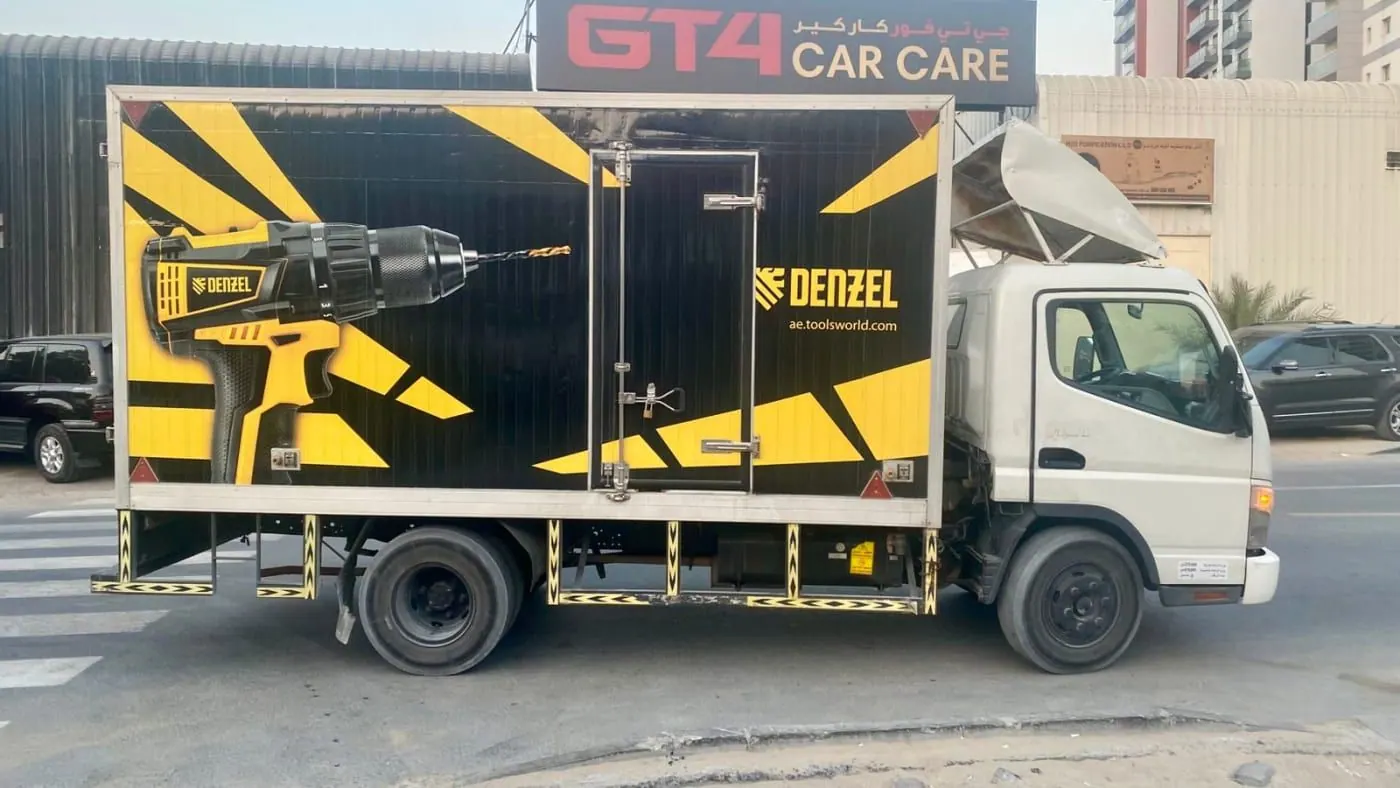
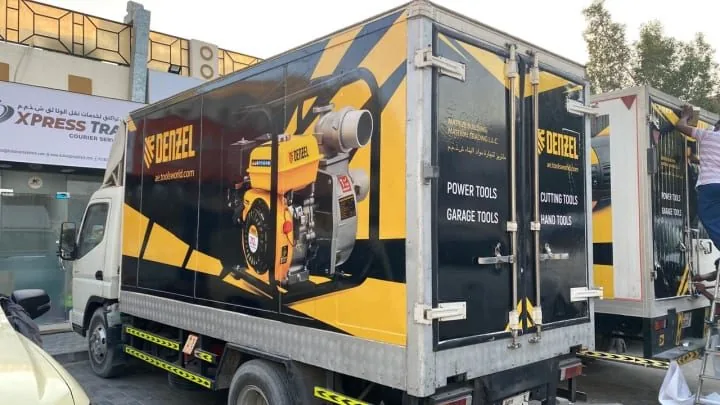
- Hinges and lock bars. Swing doors carry vertical lock bars and hinges, as in the photo above. Keep letters off them; let background colour run behind and cut neatly around them.
Rivets and ribs need cast film worked into each one. Calendered vinyl lifts around rivet heads within weeks of summer heat, a failure we describe in our guide to wrap mistakes in Dubai.
7-ton trucks, curtain-siders and trailers: long sides that move
7-ton and larger boxes
A long side is printed in several panels and joined on the truck. We plan the seams on the body's own joints so they never run through a letter or a face. One big image or one big name across the side reads better than a pattern repeated three times. On cab-over trucks the doors are small and split by steps and handles; the roof deflector, if fitted, faces oncoming traffic and mirrors, and a simple logo there is seen well before the side.
Curtain-siders
The curtain is pulled tight with straps and buckles at regular intervals, opened at every delivery and never perfectly flat. Graphics need a film made to flex, and text must sit between strap lines, not under them. Keep the phone number and website on the headboard and rear doors, which do not move. Some operators order a printed replacement curtain from their body supplier instead; the artwork rules are the same.
Trailers
Trailers often stay at Jebel Ali or a customer's yard while prime movers rotate. Brand the trailer as a standalone billboard, with name and contact on both sides and the rear, and keep the cab design simple enough to match any trailer. Corrugated container walls take film poorly across the ribs, so many clients use a flat panel or brand only the flat sections.
Chiller bodies: the easiest surface with the strictest no-go zones
Insulated GRP bodies on dairy, seafood, catering and pharma trucks are smooth and flat, so printed graphics look excellent on them. The care is in what must stay uncovered.
- The refrigeration unit and its grilles on the front of the box stay clear.
- Film stops short of door seals, so doors still close tight and the edge does not lift every time the seal flexes.
- Drain points, temperature displays and any required markings stay visible.
- Light colours on the box help keep it looking clean, and many food clients prefer them for a hygiene message.
Films, phasing and keeping the wrap alive
Match the film to the job rather than to a brand name. For printed box sides that must last, we use premium cast films such as 3M IJ180Cv3 or Avery Dennison MPI 1105, or the cast ranges from Hexis, Arlon and Mactac, always with UV lamination. For solid colour lettering on cab doors, coloured cast films from Orafol, Mactac or 3M 2080 work well. Economy calendered vinyl only belongs on flat box sides for a short promotion. Our guide to choosing vehicle vinyl explains the differences.
If the budget is tight, phase it from one master design: cab door logos and rear contact details now, the full box later. Each stage still needs to appear on the permit mockup, so plan the final design first.
Once fitted, three habits decide how long it lasts:
- Keep pressure washers back from seams, rivet lines and edges.
- On trucks with vertical exhausts, expect diesel soot on light colours behind the stack, and wash it off weekly.
- Rear corners take hits from loading dock bumpers and forklifts. Report scuffs early, while a patch can still match.
Running several trucks across emirates? Our guide to fleet uniformity covers templates and film batches.
Frequently asked questions
Which part of a truck should I brand first on a small budget?
The cab doors and the upper rear doors. Door logos show who owns the truck on site, and the rear is read by drivers stuck behind you in traffic. Add the box sides later from the same master design, and include the full plan on the permit mockup from the start.
Can graphics go on a roller shutter door?
Yes, with care. Film laid across the whole shutter cracks as the slats roll up. We cut the graphic at every slat joint and keep the design bold and simple there, or move contact details to the corner posts and header above the shutter.
Does a tail lift change the rear door design?
Yes. When folded, a tail lift usually covers the lower half of the rear doors, so anything placed there is hidden whenever the truck is driving. Put the phone number, website and any QR code on the upper half, and use the lower part for colour only.
What should I measure on a trailer before asking for a quote?
The length and height of each side wall, the rear door size, and whether the walls are smooth, riveted or corrugated. Photograph each side straight on. Tell us who owns the trailer too, because a leased trailer needs the owner's agreement for branding and the permit.
Can I move my truck graphics to a new truck?
Not the vinyl itself. Once fitted it cannot be reused, and a new body rarely has identical panels. We reprint from your master file, adjusted to the new body. The new truck needs its own permit approval; our permit renewal and cancellation guide explains what happens to the old one.
Send us your truck before the design
WhatsApp +971 56 925 9327 with the truck model, body type, side and rear dimensions, and photos of each side including the tail lift, guards and anything bolted on. We will mark the usable zones on your body and send a layout to build the design on.

Truck Branding in Dubai, handled end to end
Pickups, box trucks, curtain-siders and trailers measured, permitted, printed in panels and fitted by one Dubai team.

About the author
Printajo team, Printajo Advertising LLC. Printajo has designed, permitted and installed vehicle branding, stickers and signage in Dubai since 2014, with 5,000+ projects for 500+ UAE companies.
This guide is written from that project experience and reviewed by our production and permits team (last reviewed 4 November 2026). About Printajo · See our work