Quick answer
Low quality vinyl stickers show it in five ways: edges that lift, a gap or sticky ring where the film has shrunk, chalky faded colour, bubbles, and adhesive left behind on removal. In Dubai heat these appear fast. Ask for the exact film name, whether it is cast or calendered, and whether it is UV laminated. Cast vinyl with UV lamination lasts about 3-5 years in UAE heat.
Key takeaways
- The five signs of cheap vinyl are edge lift, shrinkage, chalky fading, bubbling and adhesive residue. You can check for most of them on a sample.
- A famous brand name is not proof of quality. Every major film maker sells economy and premium grades, so ask for the exact film.
- Unlaminated print fades in UAE sun. UV lamination over heat-resistant ink is what keeps colour for years.
- Before you pay, ask for the film name and product code and what the warranty covers. A printer who cannot tell you is the warning sign.
On this page (9 sections)
- Five signs of low quality vinyl you can see on a sample
- Why Dubai heat makes every sign worse
- Where cheap vinyl comes from, and why a brand name is not enough
- Lamination and ink: the layers you cannot see
- When each failure shows up, and what it tells you
- Questions to ask a printer before you pay
- Already failing? What to do next
- Frequently asked questions
- Tell us where your stickers are going
A sticker that looks perfect on the day it is fitted tells you very little. The difference between cheap and good vinyl shows in July and August, when the logo on a car door or a shopfront window has spent weeks in direct sun. That is when we get the calls: corners curling on a delivery car, a sticky outline around the lettering on a shop window in Deira, a red logo that has turned pale pink.
Most of these stickers were not badly printed. They were made from the wrong material for the job, and the buyer had no way to know. This guide shows you how to spot low quality vinyl stickers before you pay, from the signs you can see on a sample to the questions a good printer can answer in one line.
Five signs of low quality vinyl you can see on a sample
Every failed sticker we are asked to replace shows one or more of these. Some appear on a sample within days; others only appear after the sticker has been outside for a while.
1. Edge lift
The corners or edges start to curl away from the surface. Dust and sand collect under the lifted edge and show as a dark line, and then the lift spreads inwards. Small lettering and thin shapes lift first because they have the least adhesive holding them.
2. Shrinkage gap
The film slowly pulls back towards its centre. On cut lettering you see a thin line of exposed adhesive around each letter, which turns grey or black as dirt sticks to it. On a printed sticker, a white or clear edge appears where the print used to meet the surface.
3. Chalky fading
Colours go pale and the surface feels dry or powdery when you rub it. Red turns pink, black turns grey, and a photo loses its detail. This happens when the ink is not protected from UV light.
4. Bubbling
Bubbles that appear days or weeks after fitting, not just trapped air on day one. They come from film that cannot let air escape, from fitting onto a surface that was not clean or dry, or from vinyl stretched into a curve it was not made for, which then pulls back and lifts.
5. Adhesive residue on removal
When the sticker comes off, it leaves a layer of glue behind, or it tears into small pieces instead of peeling. On glass it means scraping; on a car it means hours of careful cleaning. Good films are designed to come off in one piece within their working life.
The first four signs mean the sticker is failing. The fifth tells you what it will cost to get rid of it.
Why Dubai heat makes every sign worse
Vinyl that lasts years in a mild climate can fail in one UAE summer. The air temperature is only part of it. A dark car door parked on a street in Al Quoz in August, or a west-facing shop window on Sheikh Zayed Road in the afternoon, gets far hotter than the air around it. That surface heat works on each weakness:
| Failure | What the heat does | Where we see it most |
|---|---|---|
| Edge lift | Softens the adhesive, so edges let go, especially on curves | Car door edges, wheel arches, bumpers |
| Shrinkage | Releases the tension built into cheap film when it was made, so it pulls back | Cut lettering on shop glass and vans |
| Fading | Strong UV breaks down unprotected ink | Car roofs, bonnets and south or west-facing windows |
| Bubbling | Air and moisture under the film expand; a cold, air-conditioned inside and hot outside glass add condensation | Shopfront glass, newly painted walls |
| Residue | Bakes the adhesive onto the surface over months | Stickers left on long after the promotion ended |
Water and dust then finish the job. Car washes with pressure jets push water under any edge that has started to lift, and summer humidity does the same overnight. This is why the material matters more in Dubai than in most places, and why a sticker that is cheap to buy is rarely cheap to own.
Where cheap vinyl comes from, and why a brand name is not enough
Most of the failures above trace back to economy calendered vinyl used for a job it was never made for. Calendered film is rolled into a sheet and keeps some tension from that process, so in heat it shrinks and fades sooner. It is fine for an indoor sale sticker that comes down in a month. On a car door or a sunny shopfront for a year, it is the wrong product.
Here is the part that catches buyers out. The brands we print and fit, 3M, Avery Dennison, Hexis, Arlon, Mactac and Orafol (ORACAL), each sell both premium cast films and cheaper calendered lines. A quote that says "3M sticker" or "Oracal vinyl" tells you the maker, not the grade. Two stickers with the same logo on the backing paper can last a few months or several years.
So treat the brand as the start of the conversation. The film name, whether it is cast or calendered, and the laminate on top are what decide how long it lasts. We compare the six brands job by job, cast against calendered, in our guide to choosing vinyl film. For stickers, the short rule is: anything outdoors, curved or meant to last more than a season should be cast and laminated.
Lamination and ink: the layers you cannot see
Two stickers on the same film can last very differently because of what is printed on it and what covers it. We describe our build as a three-layer shield: the base vinyl, the ink, and a UV lamination on top, with an optional gloss or matte protective varnish.
Ink
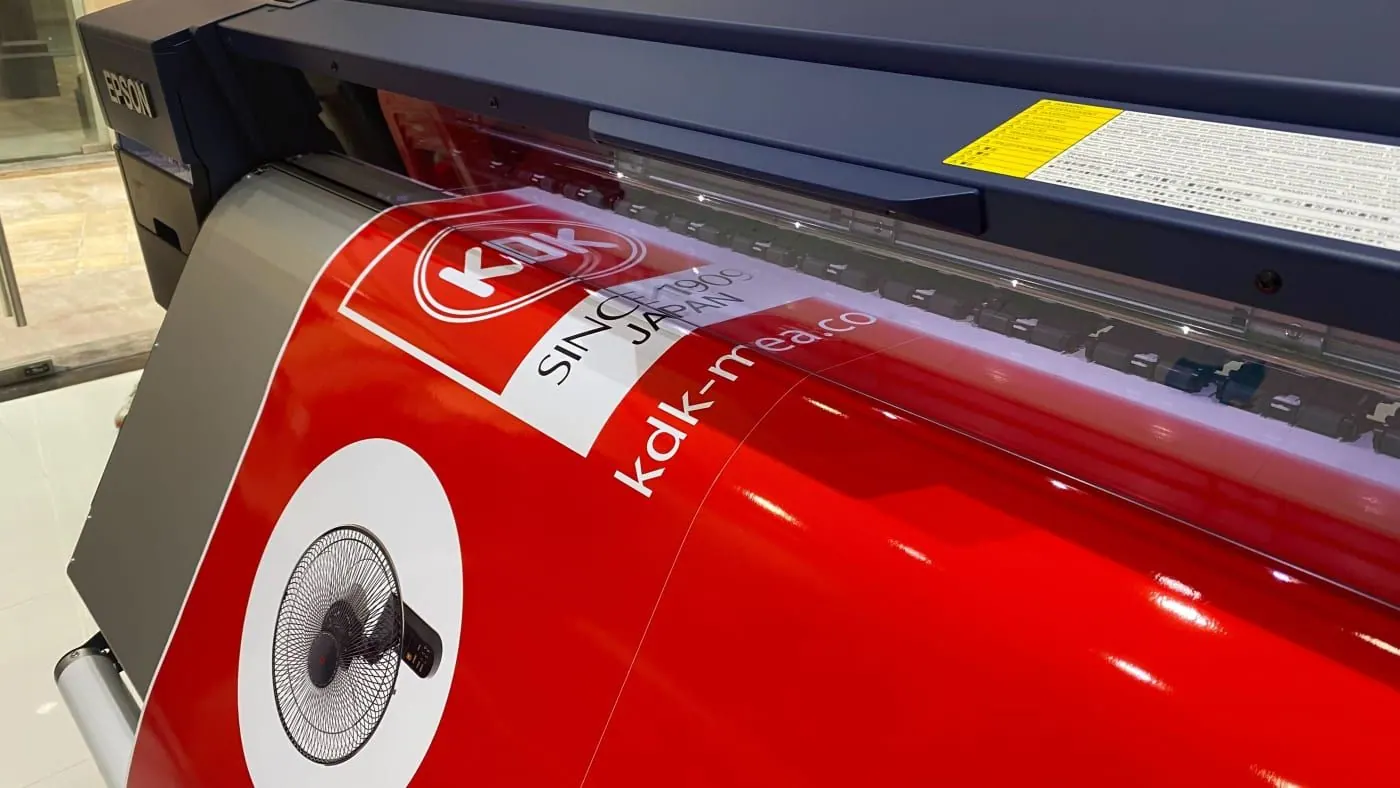
We print on EPSON SureColor high-DPI printers with original certified heat-resistant ink. Some low-cost shops run refilled or non-original ink to save money. You cannot see the difference on day one. You can see it after a summer, as fading and colour shift.
UV lamination
Lamination is a clear film fitted over the print. It blocks much of the UV that fades ink, protects the print from scratches, car-wash brushes and cleaning chemicals, and gives the finish: gloss, matte or satin. An unlaminated printed sticker outdoors in the UAE is the most common cause of chalky fading we see.
How to check a sample
- Look at the edge closely. A laminated sticker has two layers: you can often see or feel the clear film on top of the print.
- Run a fingernail across the print. Unlaminated ink can scratch or mark; laminated print does not.
- Turn it over. Branded films usually have the maker's name or product code printed on the backing paper. Ask to see it if it is not there.
- Bend the sample gently. Cast film feels thin and soft. Calendered film feels thicker and stiffer and springs back.
- Stick the sample on the real surface, in the sun, for a few days. Watch the corners. This one test tells you more than any brochure.
When each failure shows up, and what it tells you
The timing of a failure is a clue to its cause. Use it to tell a fitting problem from a material problem, or from a sticker that has simply done its job.
| What you see | When it usually appears | Most likely cause |
|---|---|---|
| Bubbles or a lifted corner | First days after fitting | Dirty or wet surface, or air trapped during fitting |
| Edges lifting on curves | First hot weeks | Calendered film on a shape that needed cast |
| Sticky outline around letters | First summer | Shrinking calendered film |
| Pale, chalky colours | Within the first summer outdoors | No UV lamination, or non-original ink |
| Brittle film, heavy glue on removal | Long after the intended life | Short-term film left up too long |
A problem in the first days is usually the fitting and can be fixed by the installer. A problem in the first summer is usually the material, and the fix is a reprint on the right film. Our work is covered for up to 2 years against peeling, lamination failure and fading, plus 6 months of free support and touch-ups; the warranty page explains what is and is not covered.
Questions to ask a printer before you pay
A good printer answers these in a sentence each. If the answers are vague, the material probably is too.
- Which film, by brand and product name? "Imported vinyl" or "good quality" is not an answer, and neither is a brand name alone.
- Is it cast or calendered? For a car or anything outdoors for years, you want cast.
- Is the print laminated, and with what? Ask for UV lamination on any printed sticker that goes outdoors.
- What printer and ink do you use? Original heat-resistant ink matters in this climate.
- What does the warranty cover, and for how long? Ask specifically about peeling and fading, and whether economy film is included.
- Who fits it, and how is the surface prepared? Even good film fails on a dusty or waxed surface.
- Can I see a sample that has been outdoors? A printer who has worked in Dubai for years will have one.
Compare quotes on these answers, not only on price. Two quotes for "vinyl stickers" can describe completely different products. Our vinyl sticker printing page lists the films and finishes we use, and the sticker printing page helps if you are still choosing the sticker type.
Already failing? What to do next
Take a close-up photo and a wide photo of the sticker before you touch it. If we fitted it, send both on WhatsApp and we check it against the job. If someone else did, the photos tell us whether the film can be saved or needs replacing.
Do not pull failing vinyl off in the midday heat or attack it with a metal blade. Cheap film tends to break into small pieces and leave glue behind, and on paint that needs a slow, warm, low-angle peel. The full method for vehicles is in how to remove a vinyl car wrap. If the replacement is going on a window and you are unsure whether to print on clear or white film, read clear vs white vinyl stickers first.
Frequently asked questions
Why did my vinyl sticker shrink and leave a sticky outline?
That outline is exposed adhesive left when the film pulled back. It is typical of calendered vinyl in heat, because the film holds tension from manufacturing and slowly returns to its original size. Cast vinyl has almost no built-in tension, which is why it keeps its size outdoors.
Is a laminated sticker always better than an unlaminated one?
For anything outdoors or handled every day, yes. UV lamination protects the ink from sun, scratches and cleaning chemicals. For a short indoor sticker that will be removed after a few weeks, lamination is optional and you can save the cost.
Why are the labels on my jars peeling at the corners?
Usually a stiff film on a curved container, a label applied to a cold or damp jar, or square corners. Thin film, rounded corners and labelling at room temperature on a dry surface fix most cases. Tell us the container and storage conditions when you order.
Are cheap stickers fine for a one-day event?
Often, yes. For an indoor exhibition or a weekend promotion, economy calendered vinyl does the job at a lower cost. Just plan to remove it soon after the event, before heat bakes the adhesive on, and keep it off curved car panels.
Will a sticker on the inside of my shop window fade?
Less than one on the outside, but glass does not block all sunlight, and a south or west-facing window in Dubai gets strong sun all afternoon. Use laminated print for anything meant to stay up for more than a short promotion.
Tell us where your stickers are going
Send us a photo of the surface, the size you need and how long the stickers should last on WhatsApp at +971 56 925 9327. We recommend a film and lamination for the job, tell you the exact film by name, and most orders are ready in 1-3 working days.

Vinyl Stickers in Dubai, handled end to end
Cast and calendered vinyl from 3M, Avery Dennison, Hexis, Arlon, Mactac and Orafol, printed with heat-resistant ink and UV laminated, ready in 1-3 working days.

About the author
Nizam Uddin, Printajo Advertising LLC. Printajo has designed, permitted and installed vehicle branding, stickers and signage in Dubai since 2014, with 5,000+ projects for 500+ UAE companies.
This guide is written from that project experience and reviewed by our production and permits team (last reviewed 4 November 2026). About Printajo · See our work


